FusionForge - An Ode to Incremental Games (Part 1)
What is an Incremental Game?
Incremental or "Idler" games – let's just call them "clicker games" if we're being brutally honest with ourselves – are a genre where you start with a simple action, like clicking a thing. Then, you make that clicking more efficient, or get things to click for you, all in the noble pursuit of watching numbers go up. A big selling point is the "idle" part: you can often just wander off, leave the game running for a few hours (or days, no judgment), and come back to a delightful little pile of progress. Sweet, sweet unearned dopamine.
These games somehow manage to trick your brain into feeling a sense of accomplishment, even while you're supposedly "working," "studying," or "socializing." They dangle clear goals, unlock shiny new mechanics, and generally give you the feeling that you're achieving something, even if that something is just becoming a virtual cookie magnate.
And don't think you're above it. From the sprawling worlds of MMORPGS to the grand designs of 4X Strategy games, a surprising number of genres you've probably sunk hours into have these incremental or idler mechanics baked right in, like secret, addictive ingredients:
- In MMOs, Take WoW, for example, with its "rested XP" system. You log out in a city, and magically, you're rewarded for not playing. Genius, really. Old School Runescape (OSRS) is practically a museum of semi-AFK skills like Woodcutting or Fishing, where the main skill being trained is your ability to click intermittently while binging a new series.
- In Simulation and Tycoon Games (e.g., RollerCoaster Tycoon, Planet Coaster – classics): The whole point is to set up systems (rollercoasters that defy physics, zoos where the lions look suspiciously content) that then churn out cash or resources over time without you having to constantly poke them. Even cozy games like Stardew Valley or Animal Crossing tap into this: the world might pause when you close them, but the satisfaction of setting things in motion and returning to a bountiful harvest (or a mortgage payment from a talking raccoon) is undeniable.
- In Grand Strategy Games (think Crusader Kings, where you can marry your horse, or Europa Universalis): These aren't strictly "idle," but your empire ticks along, generating income, spreading its (hopefully) glorious culture, and researching new ways to annoy your neighbors, often without you needing to micromanage every peasant's lunch break.
- In Roguelikes / Roguelites with Persistent Upgrades (Hades, Cult of the Lamb, Slay the Spire – some of the best indie games of the 2010s): Each run is a frantic, active sprint, but the sweet, sweet meta-progression between those runs? Pure incremental dopamine. You die, but you come back stronger (and usually with a new hat).
- In Exploration and Base Building Games (Palworld, No Man’s Sky): You start by whacking rocks with another rock, and before you know it, you've got automated mining rigs and production lines that would make Henry Ford weep with joy. Many survival games rely on this loop of investing time (actively or by just existing) to see your little patch of dirt grow into a formidable (and hopefully monster-proof) compound.
Really, this whole 'set it and forget it, then reap the rewards' thing isn't just in games. It's the dream of passive income, the satisfaction of planting a tree and watching it grow (very slowly), or even just the minor miracle of putting leftovers in the fridge and remembering them before they evolve into a new life form. Incremental games just cram that entire process into a much shorter, arguably more satisfying, timeframe, minus the risk of actual financial ruin or botulism.
Today, I wanted to waffle on a bit about what these games mean to me, and why, out of all the complex, narrative-rich, emotionally resonant game ideas I could have pursued, I chose to build one of these as my first proper game.
What Do Incremental Games Mean to Me? (Spoiler: Probably Too Much)
Incremental games have been a surprisingly significant part of my gaming diet for ages now. Ever since high school, when I was a master of divided attention – TV show on, game running, homework vaguely accusing me from the corner of my desk – I knew my brain craved that extra little hit of dopamine, especially when trying to do something allegedly productive. Check my Steam library; my most played games are almost exclusively Incrementals. Yes, that one with 5500 hours? It’s an incremental. And it’s probably still running. So, naturally, I figured, why not try to make one?
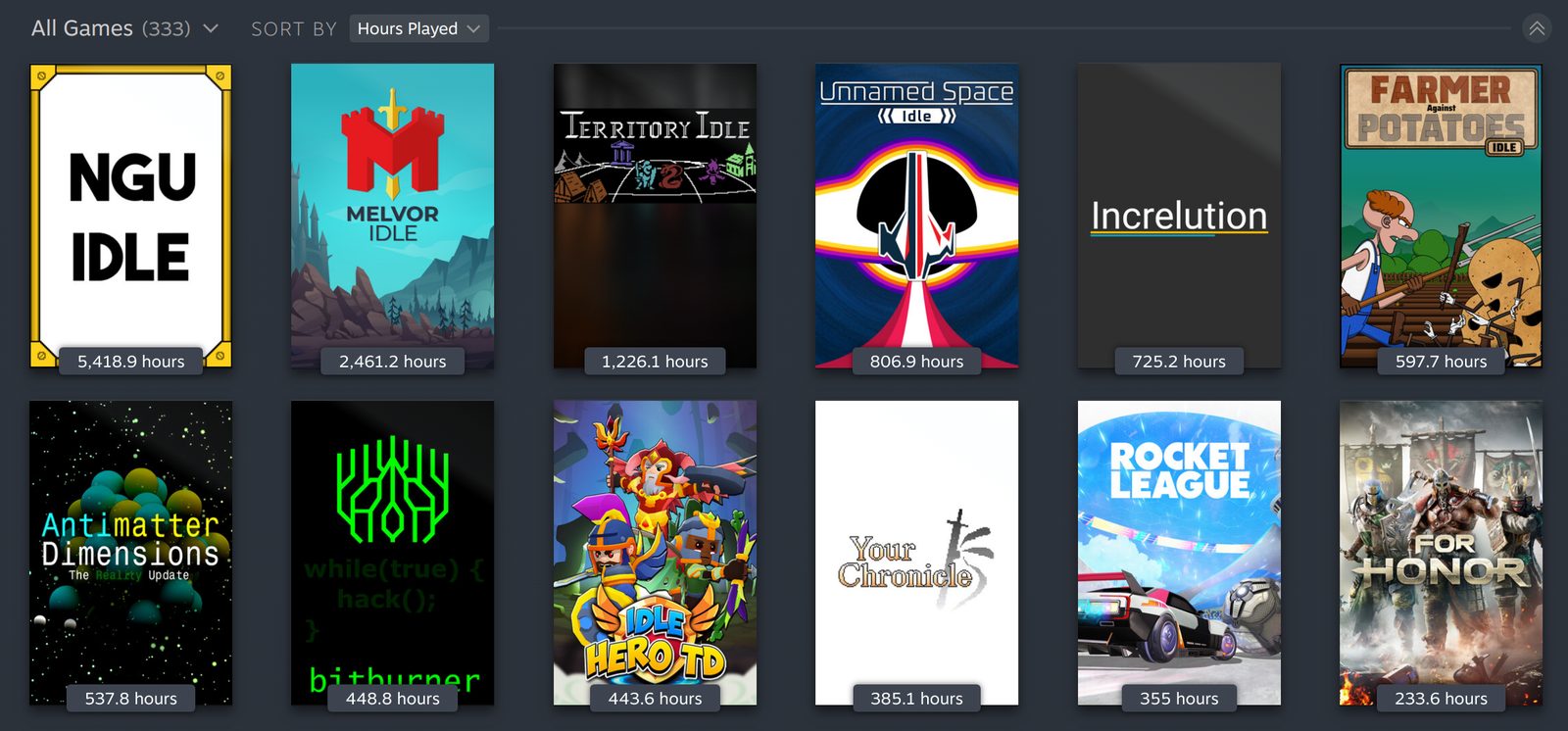
If I'm being uncomfortably honest for a moment, there have been long stretches where I’ve felt (incorrectly, my therapist hastens to add) like I wasn’t really leveling up in life – professionally, romantically, personally, you name it. These games were, and sometimes still are, a weirdly effective antidote to that feeling. The dopamine rush from finally graduating from Hopkins? Nice, sure. But does it really compare to unlocking Golden Cookies in Cookie Clicker after weeks of dedicated clicking? Debatable. Highly debatable.
Let's be honest, a big part of the appeal is the illusion of productivity. While your boss thinks you're diligently crafting that TPS report, you're actually overseeing a burgeoning empire of cookie-baking grandmas or intergalactic paperclip manufacturers. It's multitasking for the terminally distracted, and I am here for it.
Think of them as the comfort food of gaming. You're not stressed about headshots or complex political maneuvering. Nope. You click a button, a number goes up, and your brain releases a tiny, satisfying puff of 'good job' smoke. It's embarrassingly effective, like getting a gold star for remembering to breathe that actually feels rewarding.
So, Why on Earth Make an Incremental Game?
Well, for starters, making a mediocre incremental game is, blessedly, pretty straightforward:
- The core concept usually revolves around one or two simple mechanics. No need to code the next simulated universe, just make a button that makes a number go up. And maybe another button that makes the first button better.
- These mechanics are usually simple to grasp. New players can jump in and figure out the "point" (such as it is) fairly quickly, without needing a 300-page manual.
- The art style can be… let’s call it "charmingly minimalist." Often, simple text and a few well-placed buttons are all you need. Fancy sprites or VFX are either showing off or trying to distract from something.
- Your game generally doesn't need the narrative depth of a Russian novel or the thematic consistency of a Wes Anderson film. Atmosphere? That's what scented candles are for. These are things entire studios spend eons perfecting, and here, they're more of a "nice to have."
However – and this is a big, spreadsheet-filled "however" – as I’ve toiled away on FusionForge, I’ve learned that making a good incremental game, one that people actually want to leave running in a background tab for months, is a much, much tougher beast.
- The Feel™: Because you're often working with a limited set of mechanics, you absolutely have to nail how the gameplay feels. If clicking that button isn't satisfying in some primal way, or if the progression feels like wading through digital treacle, players will be out faster than you can say "prestige layer."
- Balance (Oh God, the Balance): Balancing an incremental/idler so the progression feels smooth, rewarding, and enticing – not too fast, not too soul-crushingly slow – is a Herculean task. It’s a delicate dance of numbers and formulas, and as you can see from my increasingly unhinged spreadsheets, it’s where sanity goes to die. This dictates the entire feel of your game, and when you're juggling dozens of interconnected variables, the complexity multiplies like angry, horny rabbits.
But really, the biggest, most honest-to-goodness reason I chose to build an incremental game is because I know this genre. I’ve marinated in it. I’ve seen what makes players tick (and click), what keeps them coming back, and what makes them rage-quit and write scathing reviews in ALL CAPS. Every time I play one, a tiny, arrogant voice in the back of my head whispers, “Yeah, but I could do this better.”
It’s like asking someone me they decided to learn to cook by making, chili. I’ve consumed enough to know what works, what definitely doesn't, and dang it, I wanted to try and make my own perfect bowl. (Hopefully, less heartburn with this one.)